Choosing China’s best HVAC air filter replacement suppliers requires more than comparing unit prices. A filter may look identical on a screen, yet differ in media depth, gasket quality, airflow resistance, and tested efficiency. This matters in hospitals, factories, offices, and homes where a poorly sealed panel can allow particles to bypass the filter.
The U.S. Environmental Protection Agency recommends using MERV 13, or the highest compatible rating, when household systems can support it. The guidance also warns that higher filtration can increase pressure drop. ASHRAE’s 2023 Handbook—HVAC Systems and Equipment highlights efficiency, dust-holding capacity, pressure loss, and maintenance intervals during filter selection. These factors should guide any supplier review. Not just price.
For international buyers, ISO 16890 test documentation can provide a clearer comparison of particulate filtration performance. However, test results should match the actual product, size, media, and airflow conditions. A certificate alone is not enough. Strong suppliers can provide batch traceability, dimensional drawings, material declarations, sample testing, and realistic replacement schedules. Factory audits add useful evidence, although they cannot remove every risk.
This guide examines China-based suppliers offering HVAC Air Filter Replacement products for commercial and industrial applications. It considers manufacturing experience, customization, quality controls, export support, and technical responsiveness. Some rankings may remain subjective. Buyer requirements change by climate, equipment, and operating hours. A cheaper filter may perform well in one air-handling unit and fail in another. Check the fit, pressure drop, and verified data before placing a large order.
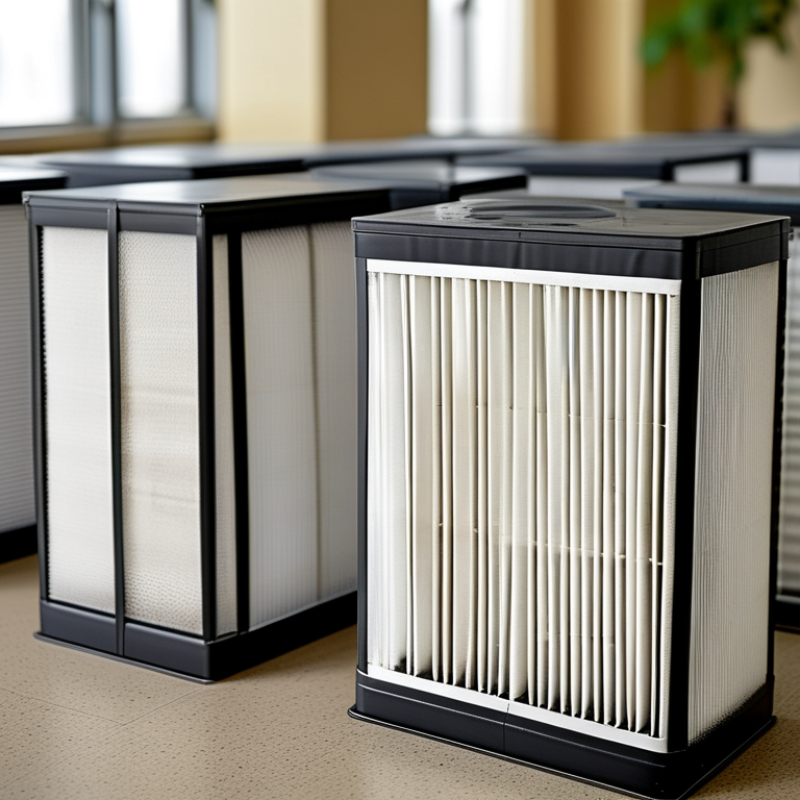
Choosing China-based HVAC air filter replacement suppliers requires more than comparing prices. Filter efficiency must match the system, the building, and the actual air quality target. MERV ratings range from 1 to 16 under ASHRAE testing. Higher numbers generally capture finer particles, but they may also increase resistance and energy use.
ISO 16890 uses ePM ratings, including ePM1, ePM2.5, and ePM10. These categories describe performance against particle sizes measured in micrometres. The test method differs from MERV, so direct one-to-one conversion can mislead buyers. A supplier should provide current test reports, airflow data, pressure-drop values, and filter dimensions. Ask for performance at the intended airflow, not only attractive laboratory figures.
A reliable replacement filter should seal tightly inside the frame. Small gaps can undermine a high-efficiency media layer. Field checks often reveal crushed edges, loose seals, or incorrect depths. These details matter. I have found that a technically excellent filter can perform poorly when installation is rushed. Supplier records should also show material consistency, batch traceability, and clear replacement guidance. One point deserves reflection: selecting the highest rating is not always the most responsible choice. The fan must handle the resistance, and the filter must suit the building’s maintenance schedule. Otherwise, efficiency claims may look strong on paper but fail in daily operation.
| MERV Rating | Minimum Composite Efficiency by Particle-Size Range | Typical HVAC Application | ISO 16890 Comparison Guidance | ||
|---|---|---|---|---|---|
| E1 0.30–1.0 μm |
E2 1.0–3.0 μm |
E3 3.0–10.0 μm |
|||
| ASHRAE Standard 52.2 MERV Efficiency Levels | |||||
| MERV 1 | <20% | <20% | <20% | Basic protection against larger dust and lint in low-demand ventilation systems. | Not directly convertible to an ISO ePM class; normally below the ISO 16890 ePM10 threshold. |
| MERV 2 | 20–<35% | <20% | <20% | Low-efficiency prefiltration for basic comfort-air systems. | Usually below ISO 16890 ePM10 classification requirements. |
| MERV 3 | 35–<50% | <20% | <20% | General dust control where low pressure drop is important. | Usually below ISO 16890 ePM10 classification requirements. |
| MERV 4 | ≥50% | <20% | <20% | Basic residential and light commercial air-conditioning prefilters. | Performance must be tested separately under ISO 16890; no automatic ePM equivalence. |
| MERV 5 | ≥50% | 20–<35% | <20% | Improved dust and pollen control in low-to-moderate airflow systems. | May approach the lower ISO ePM10 range, but an ISO test report is required. |
| MERV 6 | ≥50% | 35–<50% | <20% | Residential return-air systems and light commercial prefiltration. | Potentially suitable for an ISO ePM10 classification depending on tested results. |
| MERV 7 | ≥50% | ≥50% | 20–<35% | Commercial comfort HVAC systems requiring enhanced particulate control. | May overlap with ISO ePM10 products, but MERV and ISO results are not interchangeable. |
| MERV 8 | ≥70% | ≥50% | 20–<35% | Common commercial and residential replacement filter level for general HVAC use. | Often selected in applications comparable to lower ISO ePM10 performance, subject to testing. |
| MERV 9 | ≥85% | ≥50% | 35–<50% | Enhanced filtration for offices, retail areas, schools, and public buildings. | May provide higher ePM10 performance than MERV 8; exact ISO rating requires measurement. |
| MERV 10 | ≥85% | ≥50% | 50–<65% | Commercial HVAC systems requiring stronger control of coarse and fine particles. | Often evaluated against ISO ePM10 and ePM2.5 requirements, without direct conversion. |
| MERV 11 | ≥85% | ≥65% | 65–<80% | Higher-efficiency filtration for healthcare support areas, offices, and high-occupancy spaces. | Can overlap with ISO ePM10 and ePM2.5 products depending on actual test data. |
| MERV 12 | ≥90% | ≥80% | ≥80% | High-efficiency comfort HVAC filtration where fan capacity permits increased resistance. | May correspond to strong ISO ePM10 or ePM2.5 performance, but certification must be verified. |
| MERV 13 | ≥90% | ≥85% | ≥90% | Frequently specified for improved fine-particle control in commercial and institutional buildings. | Often selected for applications requiring high ePM2.5 performance; there is no one-to-one rating. |
| MERV 14 | ≥90% | ≥90% | ≥95% | High-efficiency systems with adequate fan capacity, sealing, and maintenance controls. | May overlap with high ISO ePM1 or ePM2.5 performance, subject to the filter’s ISO test report. |
| MERV 15 | ≥95% | ≥90% | ≥95% | Very high-efficiency filtration for demanding commercial and institutional applications. | Potentially comparable to high ePM1 performance, but pressure drop and tested efficiency must be checked. |
| MERV 16 | ≥95% | ≥95% | ≥95% | Very high-efficiency HVAC filtration where system design supports higher resistance. | May overlap with high ISO ePM1 results; an ISO 16890 report is required for classification. |
| ISO 16890 Classification | Particle-Size Reference | Classification Threshold | What the Rating Indicates | Replacement Selection Consideration |
|---|---|---|---|---|
| ISO Coarse | Coarse particles, assessed using the ePM10 size fraction | <50% average efficiency for ePM10 | Filters that do not reach the 50% minimum required for an ISO ePM10 classification. | Suitable mainly as a prefilter or for basic dust protection, subject to airflow and system requirements. |
| ISO ePM10 | Particles with an aerodynamic diameter up to approximately 10 μm | ≥50% average efficiency for ePM10 | Classified by the filter’s measured efficiency against the ePM10 particle-size fraction. | Commonly considered for general HVAC dust, pollen, and larger aerosol control. |
| ISO ePM2.5 | Particles with an aerodynamic diameter up to approximately 2.5 μm | ≥50% average efficiency for ePM2.5 | Provides a classification based on finer particulate matter than ePM10. | Useful where finer particles, combustion-related aerosols, and improved indoor-air cleanliness are concerns. |
| ISO ePM1 | Particles with an aerodynamic diameter up to approximately 1 μm | ≥50% average efficiency for ePM1 | Represents the finest of the three principal ISO 16890 ePM categories. | Often selected for enhanced fine-particle control, provided the HVAC unit can handle the pressure drop. |
| Specification Dimension | Recommended Data to Confirm | Common Units or Format | Why It Matters |
|---|---|---|---|
| Filter efficiency | MERV rating under ASHRAE 52.2 or ISO 16890 ePM classification | MERV 1–16; ISO Coarse; ISO ePM10; ISO ePM2.5; ISO ePM1 | Defines particle-removal performance and helps prevent unsuitable substitutions. |
| Nominal and actual size | Face length, face width, and overall depth | Inches or millimetres | A correct fit is necessary to prevent bypass leakage around the filter. |
| Rated airflow | Air volume used for the efficiency and pressure-drop test | m³/h, L/s, or CFM | Filter performance and resistance can change when airflow differs from the test condition. |
| Initial pressure drop | Clean-filter resistance at the specified airflow | Pa or in. w.g. | Helps confirm that the fan can maintain the required air volume. |
| Filter construction | Panel, pleated, pocket, rigid-cell, or other construction; media and frame material | Construction description | Influences dust-holding capacity, rigidity, moisture resistance, and service life. |
| Sealing arrangement | Gasket location, header seal, side seal, or track compatibility | Perimeter gasket or mechanical seal details | Air leakage around the filter can significantly reduce effective system performance. |
| Operating environment | Indoor comfort air, dusty process area, humid environment, or outdoor-air intake | Application description | Determines the required media, frame durability, moisture resistance, and maintenance plan. |
| Replacement interval | Change-out schedule based on pressure drop, loading, and operating hours | Time period or final pressure-drop limit | Replacing by condition rather than calendar date can improve reliability and energy management. |
: MERV and ISO ePM use different test methods. Direct conversion can mislead buyers. Compare airflow, particle targets, and pressure drop instead.
No. Higher efficiency can increase resistance and energy use. An older fan may struggle with a dense filter. The best choice balances capture, airflow, and maintenance.
Request current test reports, airflow data, pressure-drop values, and exact dimensions. Ask for batch traceability and material details. A label alone proves little.
H13 captures at least 99.95% of particles at the most penetrating particle size. This result comes from controlled testing. Performance can change at different airflow rates.
Small gaps can let untreated air bypass the filter media. Check length, width, depth, gasket position, and airflow direction. A tiny measurement error can cause costly rework.
Measure airflow and pressure drop at the equipment. Inspect crushed edges, loose seals, and uneven gasket compression. Field evidence matters more than attractive laboratory figures.
A low MOQ suits pilot projects and reduces inventory risk. Standard filters may take two to four weeks. Custom sizes may need six to ten weeks. Delays happen.
Use pressure readings together with the maintenance schedule. Calendar dates alone may be unreliable. Dusty buildings can load filters faster than expected. I would not trust a fixed interval blindly.
Choosing the right Hvac Air Filter Replacement supplier in China requires a clear understanding of filtration standards, product performance, and supply capabilities. HVAC filters may be classified under MERV 1–16 or ISO 16890 ePM ratings, while HEPA H13 filters can capture at least 99.95% of particles at the most penetrating particle size. Buyers should compare filter media, frame construction, airflow capacity, pressure drop, and performance data based on ASHRAE 52.2 testing.
A dependable supplier should demonstrate strong testing capacity, ISO 9001 quality management, and compliance with EN 1822 where applicable. Sourcing decisions should also consider minimum order quantities, production lead times, certifications, packaging, technical communication, and after-sales support. Effective quality control, including sample approval, batch inspection, and documentation review, helps ensure consistent filtration efficiency and reliable system operation. By balancing technical requirements with service capability, purchasers can secure replacement filters suited to commercial, industrial, and indoor air-quality applications.

 Snow Peak